
Residential vs Online IT Management Courses: Which Should You Choose?
Jul 11, 2026
If you're an IT professional weighing up how to build your management and leadership skills, one of the first decisions you'll face isn't which course to take — it's which format. Do you commit to a residential course, stepping away from work for a week of immersive, in-person learning? Or do you choose an online programme you can fit around your existing workload?
There's no universally "better" answer. The right choice depends on your career stage, your learning style, your budget, and what your employer is willing to support. This guide breaks down both formats honestly, so you can make the decision that actually fits your situation.
The quick answer
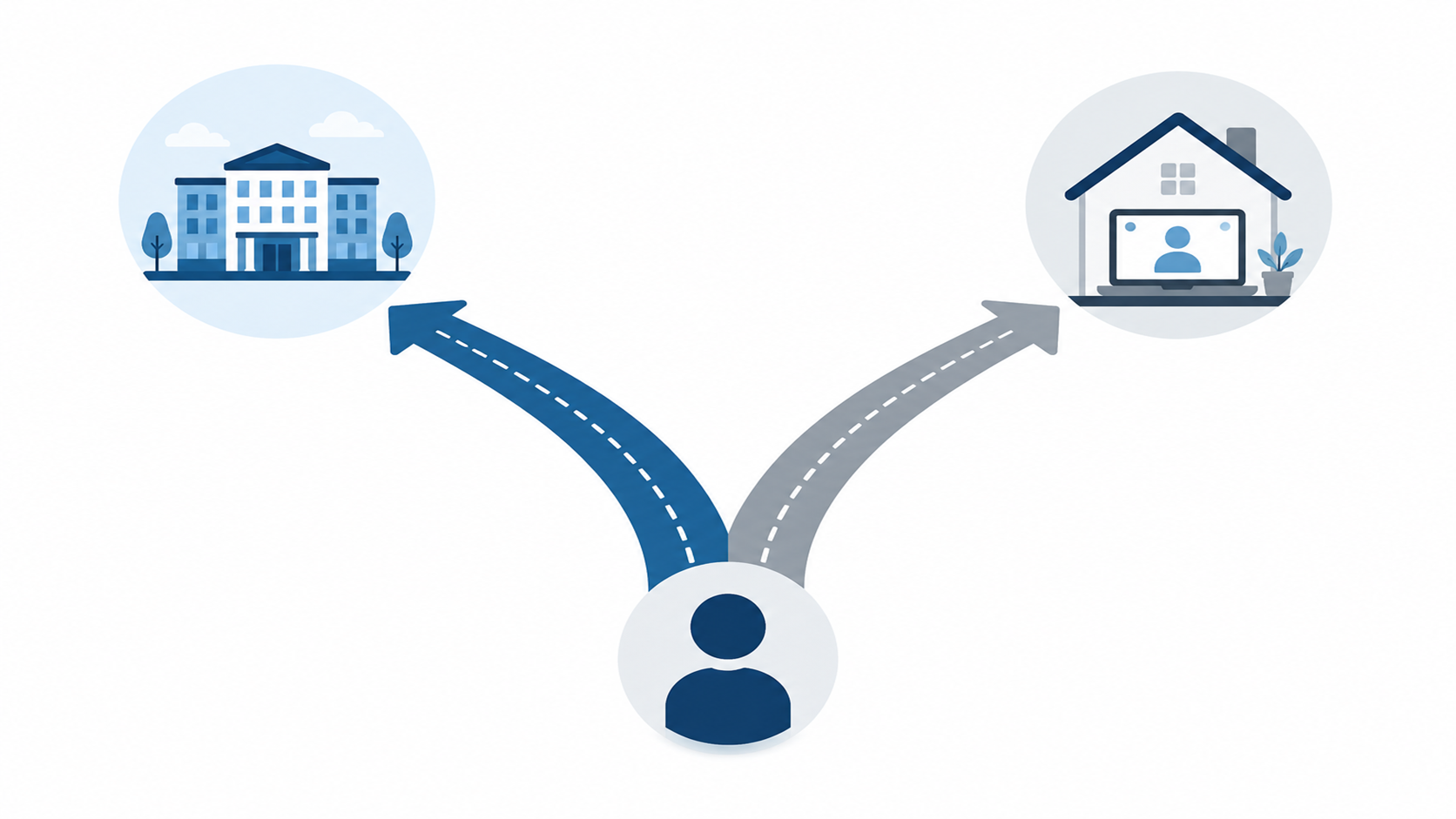
- Choose a residential course if you want immersive, distraction-free learning, the chance to build a lasting peer network face-to-face, and you (or your employer) can accommodate a week away from the office.
- Choose an online course if you need flexibility around a demanding job, want a lower upfront cost, or prefer to learn at your own pace over several weeks.
Both formats can lead to the same outcome — stronger strategic, commercial, and leadership skills — but the experience of getting there is very different. Let's look at each in detail.
What is an IT management course, and why does format matter?
IT management courses are designed to help technically-skilled professionals develop the leadership, strategic, and commercial skills needed to move into — or succeed in — management roles. Typical course content covers areas like IT strategy, project and portfolio management, operational excellence (including frameworks like ITIL and Lean IT), stakeholder communication, and commercial acumen such as vendor negotiation and contract management.
The subject matter is broadly similar across formats. What differs is how you absorb it, how much structure and accountability you get, and how much opportunity you have to build relationships with peers facing the same challenges. For a skill set that's as much about behaviour change and confidence as it is about knowledge, format has a real impact on how much sticks.
Residential IT management courses: what to expect
How they typically work:

- Delegates travel to a training venue and usually stay on-site for the duration.
- The day is structured around short, content-rich presentations (often no more than 45 minutes each), interspersed with breakout sessions and real-world case studies.
- Evenings are usually left free, giving delegates time to network informally — over dinner, in the bar, or during organised social events.
- Delegates typically leave with course materials, and often gain ongoing access to online resources and an alumni network afterwards.
Advantages:
- Full immersion. Being away from your normal environment — email, meetings, day-to-day firefighting — makes it easier to focus and actually absorb the material.
- Stronger networking. Spending five days with the same group of peers, including shared meals and downtime, tends to build more durable professional relationships than screen-based interaction.
- Structured accountability. A fixed schedule with no option to "catch up later" often suits people who find self-paced learning easy to deprioritise.
- Direct access to experienced trainers. In-person settings make it easier to ask follow-up questions and get tailored input during breakout discussions.
Trade-offs to consider:
- Time away from work. A full week out of the office requires planning, cover, and — for many people — internal approval.
- Higher upfront cost, which typically includes tuition but may exclude accommodation.
- Fixed dates. Residential courses usually run only once or twice a year, so you need to plan around the schedule rather than starting whenever suits you.
If you're weighing this option, take a closer look at how a residential IT management and leadership course is structured, including venue, format, and available dates.
Online IT management courses: what to expect
Online courses deliver the same core subject matter through a digital learning platform, typically combining short video lessons with case studies, live or recorded group sessions, and self-assessment.
How they typically work:
- Content is broken into short modules — often around 30 minutes each — that you can work through in your own time.
- Programmes are usually completed over several weeks rather than a single block, giving you room to fit study around work commitments.
- Many providers include live webinars or group discussion sessions, so you're not learning in total isolation.
- On completion, you typically receive a certificate and, in many cases, ongoing access to course materials and an alumni network.

Advantages:
- Flexibility. You can study early mornings, evenings, or weekends, without needing to step away from your role.
- Lower cost. Without travel, accommodation, and venue overheads, online programmes are typically significantly cheaper than residential equivalents.
- Self-paced progress. You can move faster through topics you already understand and spend more time where you need it.
- Easier to start. Online programmes often have more flexible enrolment than fixed residential dates.
Trade-offs to consider:
- Requires self-discipline. Without a fixed schedule, it's easy to let modules slip, especially during busy periods at work.
- Lighter networking by default. Live webinars and group forums help, but they don't fully replicate the relationship-building of shared, in-person time.
- Less immersive. You're learning alongside — not instead of — your normal job, which can dilute focus for some learners.
You can explore the structure, modules, and pricing of an online IT management and leadership programme here if flexibility is your priority.
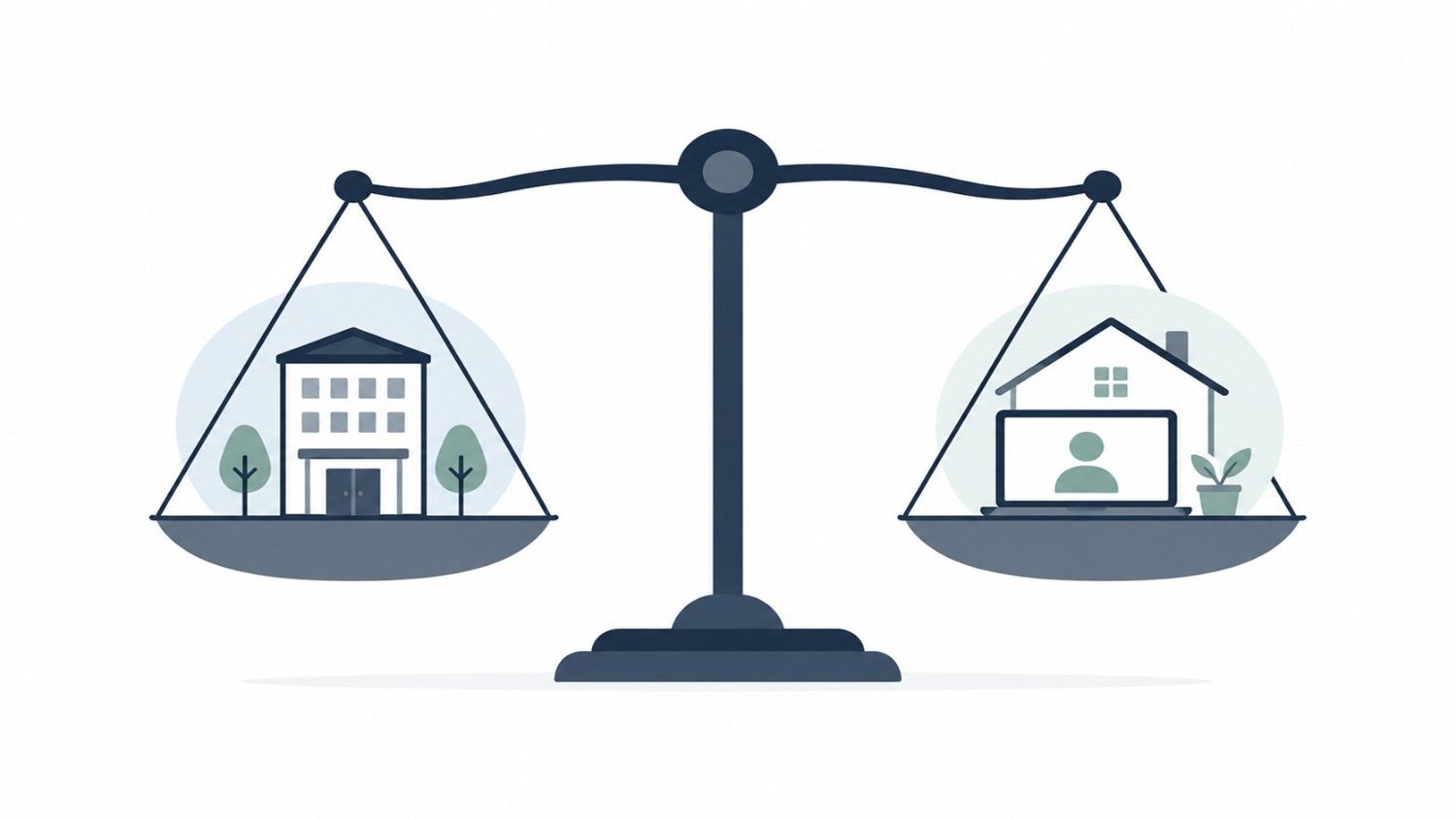
Residential vs online: side-by-side comparison
|
Factor |
Residential |
Online |
|
Format |
5-day, in-person, at a dedicated venue |
Self-paced video modules over several weeks |
|
Typical cost |
Higher (course fee, may exclude accommodation) |
Lower, often with instalment options |
|
Time commitment |
One full week away from work |
A few hours per week, spread over weeks |
|
Networking |
Strong — built through shared time on-site |
Moderate — via webinars and alumni networks |
|
Flexibility |
Low — fixed dates, once or twice yearly |
High — start and pace largely your own |
|
Best suited to |
Those who can step away and want full immersion |
Those balancing study with a demanding role |
How to decide: a simple framework
Rather than treating this as a binary choice, work through these questions:
- Can you realistically get a week away from work? If internal approval, workload, or client commitments make that difficult, online is the more realistic starting point.
- How do you learn best? If you know you need structure and external accountability to finish something, residential learning removes the temptation to deprioritise it. If you're naturally disciplined, self-paced online study can work just as well for a fraction of the cost.
- How much do you value in-person networking? If part of your goal is building a long-term professional network of peers at a similar career stage, the shared experience of a residential course is hard to fully replicate online.
- What's your budget, and will your employer contribute? Online programmes lower the barrier to entry considerably, which matters if you're self-funding or your employer's training budget is limited.
- How urgent is the skills gap? If you need to start building management capability now, online courses typically have more flexible start points than fixed residential dates.
There's no wrong answer here — plenty of professionals take the online route first and attend a residential course later in their career, or vice versa.
What to look for in a UK IT management course, whichever format you choose
Regardless of format, a few things separate a genuinely useful course from a box-ticking exercise:

- Trainers with real operational experience. Courses led by people who have actually held IT management and leadership roles — not only professional trainers — tend to deliver more credible, practically-grounded teaching.
- Case studies based on real scenarios, not generic theory. Management skills are best learned through application, not lecture alone.
- A genuine peer network, since a lot of the long-term value of these courses comes from ongoing relationships with people facing similar challenges.
- Clarity on outcomes. A good provider should be able to tell you plainly what you'll be able to do differently by the end of the course — not just what topics are "covered."
- Post-course support. Look for programmes that offer some form of ongoing access, whether that's continued community membership, refresher content, or direct contact with a course director.
Frequently asked questions
Do I need a technical background to take an IT management course?
Most IT management and leadership courses assume you already have technical grounding and instead focus on developing management, communication, strategy, and commercial skills — the areas that typically aren't covered in a technical career path.
How long does an online IT management course take to complete?
This varies by provider, but self-paced online courses are commonly designed to be completed over roughly four to six weeks, depending on how much time you can dedicate each week.
Will I get a certificate?
Reputable providers issue a certificate of completion for both residential and online formats, which you can add to your CV, LinkedIn profile, or share with your employer as evidence of professional development.
Can my employer fund the course?
Many employers support IT management training as part of professional development budgets, particularly where the course clearly links to a role progression path. It's worth raising the option with your manager or L&D team before ruling it out on cost grounds alone.
Is a residential course worth the extra cost?
It depends on what you value most. If immersive learning and in-person networking are priorities — and you can get the time away — the residential format often justifies the investment. If flexibility and lower cost matter more, an online course delivering the same core curriculum can be just as effective.
Making your decision
Both residential and online IT management courses can build the same core capability: the ability to lead confidently, think strategically, and operate as a trusted business partner rather than "just" a technical function. The right choice comes down to your circumstances, not which format is objectively superior.
If you'd like to talk through which option fits your situation, get in touch with the IT Leaders team to discuss course dates, format, and pricing for both our residential and online programmes.
Stay connected with news and updates!
Join our mailing list to receive the latest news and updates from our team.
Don't worry, your information will not be shared.
We hate SPAM. We will never sell your information, for any reason.